You have made a decent start Zoe - using lots of media language and sometimes discussing the meaning of the elements you have picked out. However you have described too much without then analysing (suggesting meaning) and because of this your work is in a level 2. In order to improve you should:
Think about the questions below, ensure you are addressing all of them.
Embed JPEG images throughout and a video of the opening in order to illustrate your analysis.
Study the opening sequences of any film from the Thriller, Horror, and Romantic comedy genre. E.g. Seven, The Dark Knight Rises, Halloween, Notting Hill, Love Actually etc. Analyse how the sequence has been constructed through its use of: Camera angles, shots, movement, Editing, Sound, Special effects and Mise-en-scene etc.
·In terms of editing how have the separate images been put together - Think in terms of frequency of cuts, fades in/out, jump cuts, dissolves etc.
·What visual images appear on screen throughout the sequence? And what do they mean?
·Describe what narrative (story) is being displayed in the sequence from start to finish.
·Describe what kind of music; diegetic/non-diegetic/incidental/ambient etc. is being played over the sequence.
·How and what titles are being displayed during the sequence and in what order.
·What kind of characterisation is evident? - Age, gender, relationships etc.
The Woman In Black is a British Horror film, written by Jane Goldman, based upon Susan Hill's novel 'The Woman in Black.' The film was directed by James Watkins, and produced by Hammer Film Productions. The film stars the likes of Daniel Radcliffe, Liz White, Sophie Stuckey, Ciaran Hinds, and Janet McTeer.
Analysis:
The opening scene fades in from black and starts with soft, non-diegetic melody similar to that of an old lullaby found within a children's music box, this gives the viewer a sense of tension, as old lullaby's are known to be creepy. It also gives the impression that is scene is about to introduce children, or babies, and that it is set in the distant past, most likely to be around the Edwardian-Victorian era. The first scene the camera shows is a close up of a china tea set. The Tea pot, is poured into the tea cups, however no tea comes out, Immediately this gives the impression that it is a child's tea set, that they play with.
The camera then zooms out, and focuses on one of the teacups being picked up a small child's hand. It then pans slightly, to show the child's hand and an old handmade doll. The child'd hand, feeds the doll the small tea cup. This shows that it is a child playing with a toy china tea set, and that the child is most likely to be female.
It then jumps to another teacup in a child's hand, that hand is also feeding a doll the teacup however, this doll is an old fashioned china doll. The dolls clothes are old fashioned, and point to that of the Edwardian times. The fact there are two dolls, and two hands from different directions give the impression that there are more than one child playing, and perhaps they are playing together. The non-diegetic music starts gradually increasing in volume at this point.
The scene then jumps to three young girls, in old Edwardian clothes. They are in beautiful, long lace dresses showing a sign of wealth. They also have aprons over the top of their dresses, this gives the impression that they had to stay clean and tidy, The young girls are sat around a small table, playing with dolls and a china tea set this shows that the hands in the previous shot must belong to these girls, and that they are all playing nicely together. The young girl on the far right, then passes the young girl on the far left a dolls hair brush. The camera then zooms in, showing the girls hand brushing the hair of another china doll. The china doll has a crack through it's eye. This could show that it has fall from a height in the past, or an accident has happened. This could also give the impression that an accident is going to repeat itself.
The camera then jumps to the first, handmade doll being tucked into a toy bed, The fact she is putting it to bed, shows that the day is ending. This could give an insight that something is about to come to an end within the film. The camera then zooms out to show two of the young girls smiling, it then does a reverse shot to show the other young girl smiling back at them. This portrays conversation, and happiness. It shows that the girls are happy to be within each others company. The young girl then looks downwards, towards her toys. The camera pans, following her movements. It shows her hand putting the china teacup down onto a saucer on the floor. The camera then jumps to a point of view shot, as if someone is watching them from the doorway. We later find out that this is from The Woman in Black's eyes. The young girl on the far right, looks up towards the camera as if something, or someone had caught her eye, the young girl in the center followed her lead and looks up too, followed by the young girl on the far left. The non-diegetic music's volume increases further creating tension, and bracing the viewer for what event is about to happen next.
The camera jumps to another point of view shot, at the eye level of the young girls showing all three girls sitting on the floor. The girls eyes all look over to the right hand side, towards the window, at the same time, in a swift movement as if someone is telling them to do so.
The camera then jumps to face the window, this is another point of view shot showing what the girls are looking at. The camera then pans in towards the window. The camera then flashes back to the point of view shot facing all three of the young girls, as they stand up together slowly, almost in rhythm. This gives the effect that something, or someone is calling them towards the window. The camera then zooms in to a close up of each child's hand, as they drop whatever it is they are holding. This shows that something has grabbed there attention, and their mind is now only focused on that. It then zooms out very slightly to a medium close up of the girls shoes. The camera stays still as all three girls walk past slowly in rhythm. It then zooms back into a close up of the girls treading on their toys, breaking them as they go. This gives the impression that something, or someone has taken control of their mind, and body. One of the girls stand on their china dolls head, and it smashes. This portrays death. The camera then zooms out into a medium shot, facing the girls. In the background of this shot, within the shadows there is an insight as what is controlling them. The 'Woman in Black's' figure is standing there. This gives a sense of dread, and mystery. It makes us question why she is standing there, what she wants from the children, and whether or not she is a real person.
It uses tracking backwards, mimicking the steps the three girls take towards the window. The non-diegetic music increases volume further, creating more and more tension. The camera then turns to the back of the girls as they reach the window, and step up onto the ledge in time with each other, equally spaced out between the three window panes.
The camera stays deadly still, as the three girls reach toward the handles of the window they are standing in front of. The camera then zooms in to a close up of one of the girls hands on the handle, opening the window. This gives a sense of mystery and tension. It then zooms out to all three girls opening the window at the same time. This leaves the viewer questioning why they are opening the window, and following the exact movements in rhythm. Without any camera movements, the girls all step up to the edge of the open window, in time with each other. The non-diegestic music then becomes loud, and the notes become longer. This creates a big build up of tension for the viewer.
The young girls all take on big jump, out of the window in time with each other. The music holds one note for five seconds, then cuts out to silence. The silence symbolises the event that has been building up tension, has arrived. Three seconds after the silence a womans voice screams, and cries 'My babies' This creates a feeling of sadness, as it allows the viewer to know that the children were loved dearly. After the scream the camera pans away from the window, back into the childrens room, and the distant sound of three drums banging can be heard. This symbolises the three lives that have just been taken. The camera then jumps to the face of the china doll with a crack through it's eye this portrays that the crack in the eye wasn't a symbol of the past, but was infact a symbol of the future. The camera then jumps back, and continues panning out of the girls room. Once it reaches the exact position the camera was at when it was showing a point of view shot from the Woman in Black's eyes, the scene fades out. This symbolises that it is not the end, and The Woman in Black, is still out there and is not about to stop.
An introduction to the film: Mission Impossible 2 is an Action-Thriller, that was released in the year 2000. It was Directed by John Woo, and stars Tom Cruise, playing the main character Ethan Hunt, and also serving as one of the films producers alongside Paula Wagner (Cruise/Wagner productions) and Paramount Pictures. Mission impossible 2 is about a secret agent (Ethan Hunt) who is sent on a mission to Sydney, in order to destroy a genetically modified disease called 'Chimera.'
Analysis: Mission Impossible 2 starts with upbeat, non-diegetic funk music, this makes it seem as though it is going to be a happy, and relaxing start to the film. It is set in a desert, full of red rocks. This gives the impression that it is extremely dry, with a lack of water. The first scene starts with an establishing shot of the cliffs, this shows the height of the cliffs, this portrays danger, and gives the audience an insight of the tension to come. The birds eye view that is used within the establishing shot, along with the diegetic sounds of a bird squaking makes it seem as though there's an eagle watching over the rocks, like a predator. This creates a sense of danger lurking around the corner.
The camera zooms into a full body shot showing a man, Ethan, climbing the rocks without a harness. The non-diegetic funk music is still playing in the background at this point. This portrays a lack of fear within the man. The camera then zooms out to a medium long shot, and pans across the scene showing the length of the rocks.The length and height of the rocks give the impression that the man is on a long journey.
There is a high angle shot of Ethan looking down on an area of the cliff, this angle has been used to suggest he is powerful. It then zooms in to a medium long shot, and goes into slow motion showing Ethan jump from one ledge to another. This creates tension and give the impression that he is willing to take a risk. Once he has jumped over the gap, and landed safely, the film goes back to normal speed, and Ethan swings from the rocks, like a monkey. This implies that he is in touch with his wild side. He then hangs from the rocks, from his hands, the camera zooms into a face shot, showing his expression. His face gives the impression that he is relaxed, and relieved. It then zooms out to a full body shot. His body is positioned in a way that Jesus was positioned on the cross. This is a religious symbol and shows that he has Jesus-like qualities, making him seem like a hero, or a savior.
The next scene shows starts with the diegetic sound of a helicopter, however the audience is as yet unable to see it. This creates a sense of tension because the audience are currently unaware whether or not it is a threat. The camera is still focused on Ethan climbing the cliff, up until he reaches the top. Once he has reached the top of the cliff, the volume of the non-diegetic funk music that has been playing all the way through the opening, increases. This portrays a sense of success. The camera then turns to an establishing shot looking down upon him. This gives the impression that it is a point of view shot, coming from the helicopter we can hear, increasing the sense of tension because the camera angle makes Ethan seem small, and vulnerable. When the helicopter appears in the scene, it is shown flying up above the rocks, this gives the impression of some kind of military operation. This impression is continued, and creates further tension when a man in the helicopter points a gun and fires a canister at Ethan. The camera then zooms into Ethan to full body shot, this shows him opening the canister, and the tension drops as we realise that he is not under threat. Once the canister is open there is a close up of the high-tech sunglasses. This creates a sense of mystery, making the audience wonder why Ethan has access to such high technology, in the center of a desert. The camera then focuses on a face shot of Ethan putting the glasses on. Within this scene, there is dialog, between Ethan, and the mysterious person behind the high-tech sunglasses. The conversation between them explains that Ethan is on holiday, giving the non-diegetic funk music a purpose. The males voice from the Sunglasses then gives Ethan a 'mission.' This answers all of the audiences questions about his strength, fearlessness, ability to take risk and reason behind his access to such high-tech equipment.
The Genre I have chosen for my movie opening is Horror.
What is horror?
A film that plays on the audiences fears
Focuses on eerie atmospheres.
Attempt to startle the audience
Stereotypically involves supernatural elements.
Includes many sub-genres (as seen below)
The most common codes and conventions include screaming, blood, death, violence, specific victims, and isolated settings, chase sequences
Horror movie sub-genres:
Comedy Horror (Combination of comedy and horror)
Action Horror (Combination of Action and horror, typically the eerie settings, and characters of horror films with tense and frantic chases of action films)
Psychological horror (Based upon characters fears, focusing on psychological dread)
Science fiction horror. (Combination of Sci-Fi and Horror)
Body Horror (focuses on graphic destruction or mutilation of body parts e.g disease causes body to completely decay whilst living)
Gothic Horror (Psychological terror in historically romantic settings e.g. castles)
Supernatural horror (paranormal, zombie ect)
Japanese Horror (It is similar to supernatural horror, however focuses on unique and innovative story lines, often based upon old folks-tales with a modernised twist)
Slasher (Graphic violence, commonly with knife/chainsaw ect)
Dark Fantasy (Fantasy elements with a twist of horror, e.g. horror in a fantasy setting)
Thriller-Horror (based upon real life events e.g serial killers ect)
The sub-genre I have chosen for my horror movie is Supernatural Horror.
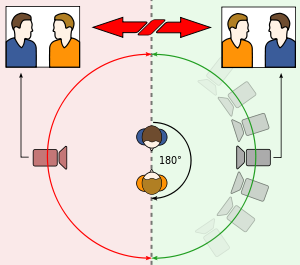
180° rule The 180° rule is a basic guideline when film making. It is said that two characters, or a character and an object should always have the same left and right relationship on screen. There is an imaginary line, called the axis, that will connect the characters if keep the camera is kept on one side of the line for every shot. The first character should always be on the right hand frame of the second character that should be on the left hand frame. The object must always stay in the centre whilst the camera faces towards the object. If the camera is to cross over the line, you must show that you are crossing the line. The camera passing over the cross over the axis (the invisible line) it is often called 'crossing the line' or 'jumping the line' We didn't include this in our film as we didn't have a scene where this was incorporated. To improve our film I would redo it and put a scene in where we use the rule.
Match on match action
Is a cut between two shots that place two different shots
of the same action next to each other. This makes the shots flow smoothly without interruption. This is part of a editing technique called continuity editing. It is also known as 'cutting on action'.We have an example of this when Georgia is typing on her phone - we started with a long shot, then cut to a
medium shot and then close up of her typing into her phone. We edited the film in premiere pro and edited the shots into a 'match on match' action.
Eye-line match
This means that the eye-line of the person in one shot has to line up with the person/ thing they’re looking at in the next shot. in order to get this to work effectively, you need to put both camera positions at a similar distance from the ‘axis’ If one person is taller than the other, the taller person should be looking down, and the smaller person should be looking up. We didn't incorporate this into our film as we didn't get a chance to film the scene.
How did the film making go?
Although the filming process was slow, due to us being unfamiliar with the cameras, and how to film (as evident with the short amount of footage we created) I think the filming went well.We tested different shots - long shots, medium shots and close ups. We also experimented with panning but the results were unsuccessful. There were certain shots in which we were talking, or giggling where we didn't want it, however we managed to cancel this out during out editing process by adding music. I struggled with editing to start with, but as I became more familiar with Premiere Pro, I became more confident and enjoyed learning how to use the software.
What have I learnt?
During this task, I learnt how to use the camera and understand what different shots are, and how to use them. I learnt how to cut down pieces of footage and edit them to transition into each other in Premiere Pro. I also learnt how to layer music on top of the footage we had filmed and how to arrange the shots so that they flow into each through a 'match on match' shot.


.jpg)